

Aircraft Insights
The AriyaX Legacy 650 cabin is arranged across three distinct zones for up to 13 passengers, supporting work, dining, privacy and rest within one journey.

The value of a private aircraft cabin is not measured only by its length. It is measured by how naturally the space supports the people travelling inside it.
Some passengers need to work. Others may want to dine, hold a private conversation or step away from the main group. On longer journeys, the ability to move between different environments can be more valuable than a single open cabin with more seats.
AriyaX’s featured Embraer Legacy 650, VP-CYH, is configured for up to 13 passengers across three distinct cabin zones. Its layout brings together an executive club area, a conference and dining section, and a private aft lounge within one aircraft.
This is not simply a question of capacity. The three-zone arrangement allows the cabin to change with the journey.
A private flight may begin as a working environment, continue with a meal and finish with a quieter period before arrival. The Legacy 650 cabin supports these changes without requiring every passenger to use the space in the same way.
The aircraft’s floor plan separates the main passenger cabin into three functional areas:
Cabinetry, partitions and the length of the cabin help create a sense of separation between these areas. The result is useful for executive groups, families, delegations and private parties whose requirements may change during the same flight.
The floor plan shown on this page represents AriyaX’s featured Legacy 650 configuration. Other Legacy 650 aircraft may have different seating layouts, materials and onboard equipment.

The forward passenger section is arranged with four individual leather seats in a club configuration. This area is suitable for conversation, focused work or a quieter start to the journey.
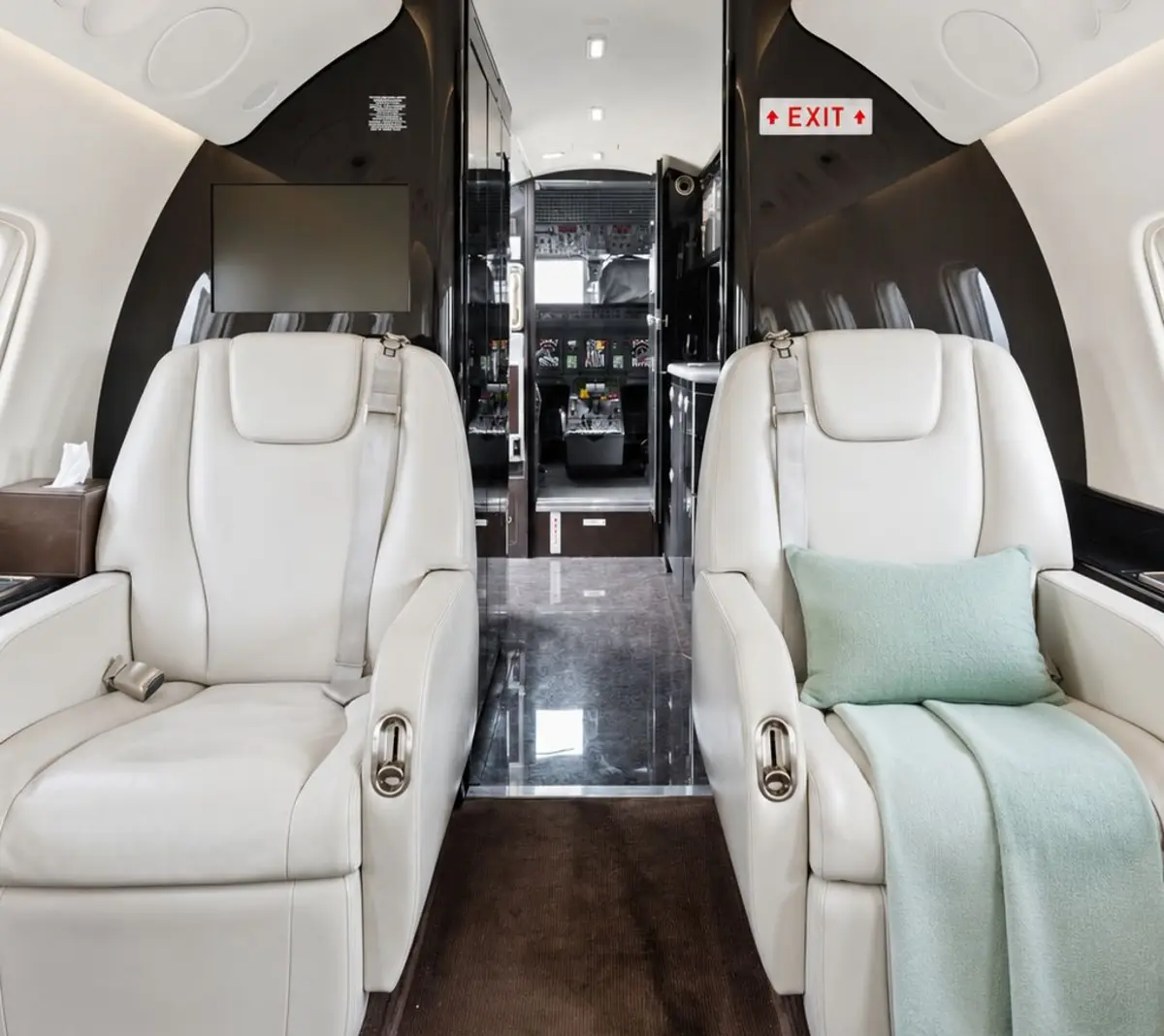
Individual seating gives each passenger a defined place while retaining direct access to the aisle. Side tables can support documents, personal devices and light refreshments without turning the entire cabin into a meeting room.
For executive movements, this zone may be used by principals, advisers or members of a leadership team who need to remain engaged during the flight. For family travel, it can provide a separate area for passengers who prefer individual seating away from the larger social section.
The value is flexibility. Four passengers can sit together without occupying the conference area, while the remaining cabin stays available for other uses.
The central cabin provides a shared setting for meetings, dining and group conversation. Opposing seats and a larger table create a practical environment when passengers need to review documents, discuss an agenda or share a meal.
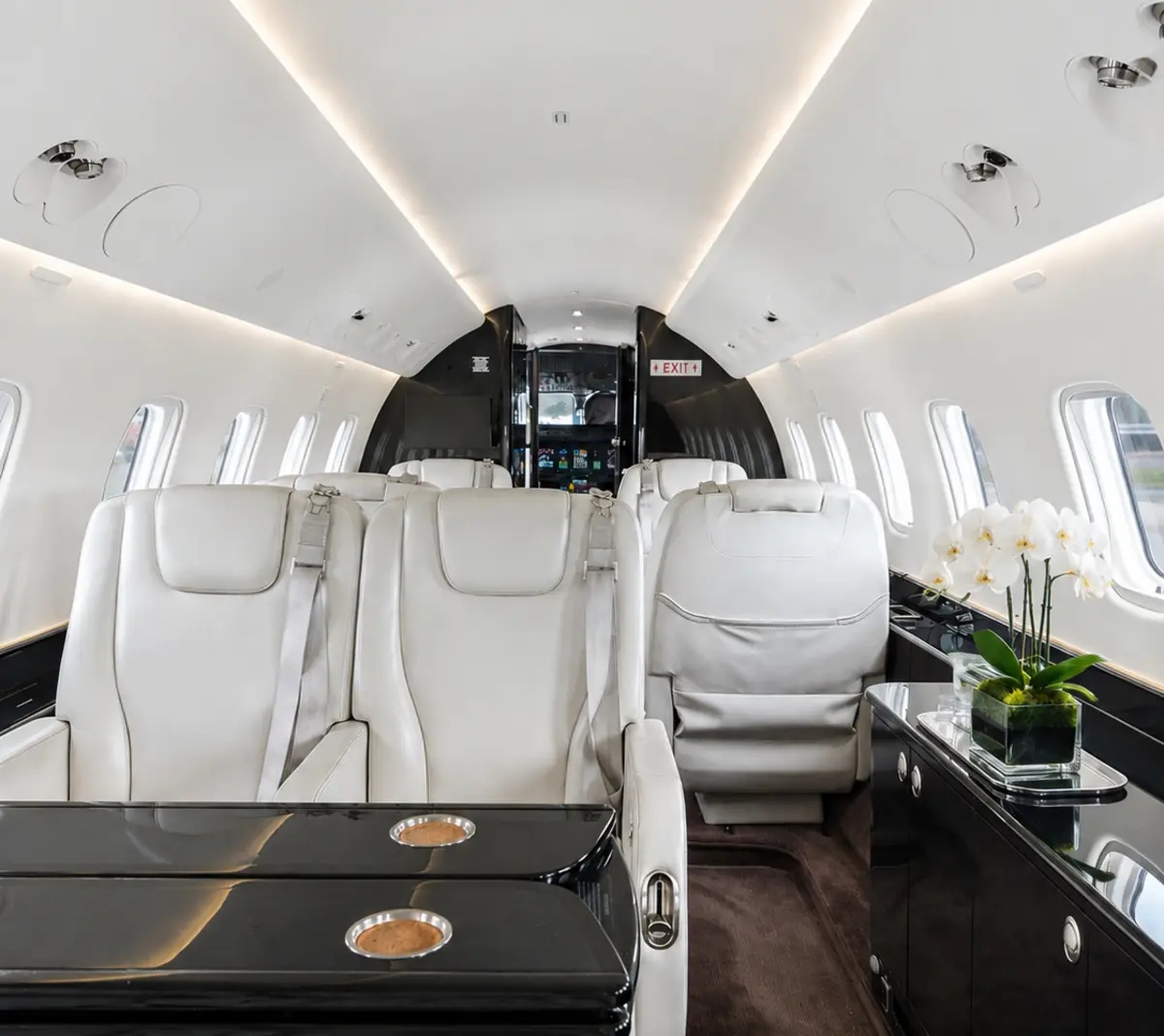
This section can be particularly relevant for corporate teams and family offices. A discussion can continue after departure without requiring the complete cabin to participate. At other times, the same space can become the main dining area.
A conference configuration should not be treated as a substitute for an office. Connectivity, call quality, device charging and cabin-service arrangements should be confirmed for the particular mission. However, the physical layout gives passengers a structured setting that is difficult to recreate in a smaller or single-zone aircraft.
For groups travelling together, the central table also creates a natural point of contact between the more individual forward seating and the private lounge at the rear.
The aft cabin is arranged as a more relaxed and private space, with individual seating and a side-facing divan. Its position at the rear of the passenger cabin provides greater separation from activity in the forward zones.
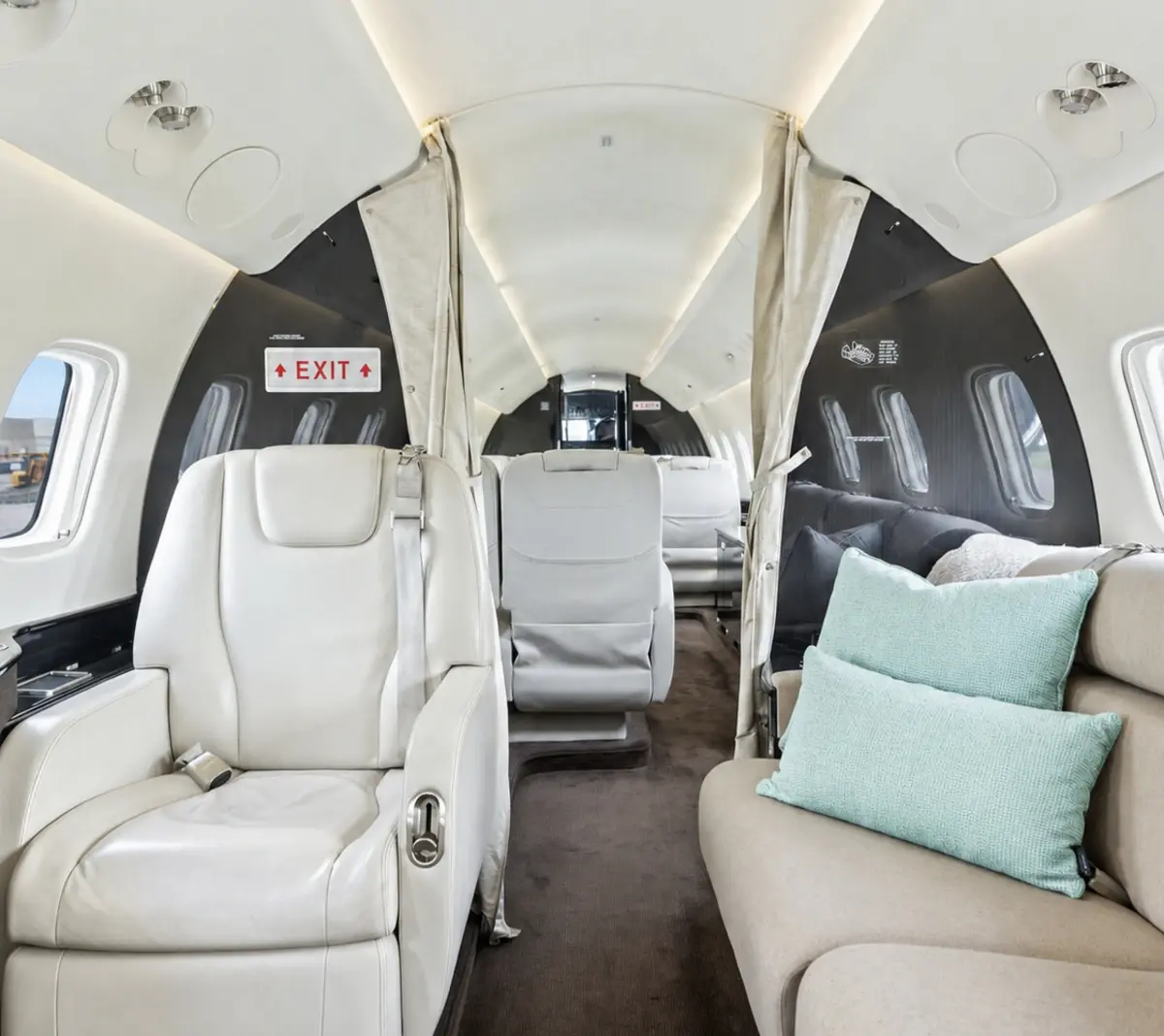
This area may suit a principal who wants time away from the wider group, a family seeking a calmer space, or passengers who wish to rest before arrival. The divan and softer lounge arrangement create a different atmosphere from the executive and conference sections.
The aft lounge should be described as a space for rest and privacy, not automatically as a certified bedroom. Any sleeping arrangement, bedding request or use of berthable seating must be confirmed for the specific aircraft and operation before departure.
For longer journeys, the ability to separate work, dining and quiet time can help passengers arrive with more control over how they used the hours in between.
The floor plan makes the aircraft’s internal logic easier to understand than a collection of cabin photographs alone.
At the forward end, service and storage areas sit close to the entrance and executive club section. The first four individual seats form a defined working or conversational zone. The central group seating and table create the conference and dining area. Farther aft, the cabin transitions into the lounge, where the divan and individual seats provide a more private environment.
The three sections do not require the cabin to serve one purpose throughout the flight. Passengers can move between individual seating, a shared table and a more private lounge as their priorities change.
The standard floor plan shows the aircraft prepared for up to 13 seated passengers across its three zones. For suitable flights, selected opposing seats and the aft divan may be prepared to support rest.
When prepared in the represented sleeping layout, the cabin can provide up to five sleeping positions:
Indicative arrangement: final berth preparation, bedding and availability remain subject to confirmation for the specific aircraft and flight.
The description “up to five sleeping positions” is more precise than “five beds.” It explains the practical arrangement without suggesting five enclosed bedrooms or five permanently installed beds.
The represented aircraft is configured for up to 13 passengers. Capacity alone, however, does not describe how the cabin works.
A full passenger group may include individuals with different priorities. Some may continue working, some may prefer a shared meal and others may require privacy. The three-zone layout helps separate those needs while keeping everyone within the same cabin environment.
For a particular flight, the final passenger limit and seating plan remain subject to the aircraft documentation, payload, baggage, route and operating requirements. Passengers should also provide the number and age of any children, details of reduced-mobility requirements and any seating preferences before confirmation.
The Legacy 650 combines its three-zone cabin with approximately 240 cubic feet, or 6.8 cubic metres, of baggage capacity. This can be valuable for longer journeys, family travel and movements involving presentation materials, formalwear or other substantial luggage.
Published baggage volume is not an automatic loading guarantee. The number of bags that can be accepted depends on their dimensions, weight and shape, together with the passenger payload and mission requirements.
Hard cases, golf equipment, pushchairs, mobility equipment and oversized items should be declared with measurements before the flight is confirmed. This allows the loading plan to be reviewed against the actual requirement rather than an assumed number of standard bags.
The represented aircraft includes SwiftBroadband connectivity and cabin entertainment features. These can support communication and media use during the journey, but service coverage and performance may vary by location, network availability and operating conditions.
Passengers with a critical connectivity requirement should explain what they need to accomplish during the flight. Email access, messaging, voice calls, video conferencing and large data transfers place different demands on an airborne connection.
Cabin-service arrangements, catering and passenger preferences should also be confirmed for each mission. Dietary requirements, allergies, preferred meal times and special requests are best provided before departure so the service can be aligned with the schedule and cabin plan.
The Legacy 650 has a published maximum range of approximately 3,900 nautical miles. That figure is useful for understanding the aircraft category, but it does not confirm that every route within that distance can be operated nonstop.
Actual mission capability depends on passenger and baggage payload, winds, temperature, routing, airport performance, fuel requirements, reserves and current operating conditions. The cabin may suit a journey, but the complete mission still needs to be reviewed before the aircraft is confirmed.
This distinction is especially important when passengers are comparing aircraft using published specifications alone. The right choice considers both the environment inside the cabin and the operational requirements outside it.
The Private Jet Aircraft Guide provides additional context on matching aircraft categories with passenger, baggage and route requirements.
The configuration is particularly relevant for:
The aircraft should still be selected against the complete mission. Passenger count, baggage, departure and arrival airports, schedule, ground time and onward arrangements all influence suitability.
The strongest feature of the Legacy 650 cabin is not a single seat or table. It is the ability to give different parts of the journey their own place.
The executive club supports individual work and conversation. The conference and dining area brings passengers together. The aft lounge creates distance when privacy or rest becomes more important.
For suitable missions, AriyaX’s featured Legacy 650 offers a cabin that can move with the passenger’s priorities rather than asking the entire journey to fit one setting.
Explore the Embraer Legacy 650 private jet charter page for aircraft specifications, route considerations and charter enquiries.
The represented Legacy 650 is configured for up to 13 passengers. Final passenger capacity remains subject to the route, payload, aircraft documentation and operating requirements for the mission.
The aircraft is arranged with a forward executive club area, a central conference and dining section, and a private aft lounge. Each zone supports a different use of the cabin during the journey.
Yes. The floor plan is presented as the configuration of AriyaX’s featured Legacy 650, VP-CYH. Other Legacy 650 aircraft may have different interiors and seating arrangements.
The three-zone layout creates greater separation between activities than a single open cabin. Actual privacy depends on how the cabin is being used and the position of partitions and doors.
The central zone includes opposing seating and a table suitable for meetings, document review, dining and group conversation during the flight.
The aft lounge divan may be prepared as the fifth and widest sleeping position in the represented layout. Bedding, berth preparation and final availability should be confirmed for the specific operation before departure.
The represented sleeping configuration provides up to five positions: two in the forward executive club, two in the central cabin and one in the private aft lounge. This is separate from the aircraft’s maximum seated passenger configuration.
The represented aircraft provides approximately 240 cubic feet, or 6.8 cubic metres, of baggage capacity. Final acceptance depends on the number, dimensions and weight of the bags together with the complete mission payload.
The represented aircraft is equipped with SwiftBroadband connectivity. Coverage, speed and service availability can vary by geographic area, network conditions and the requirements of the flight.
The aircraft may be requested for suitable regional and international missions, subject to its position, availability, route feasibility and final operational confirmation.